Friday, May 8, 2009

A Year of Documented Learning


Astronomy:
This past year I began learning astronomy. My favortie activity in astronomy was when Mr. Getty came and we used models of the solar system to develop a better understanding of space and how it works. Using computers we changed the velocity and mass of the planets and the sun and studied stable orbits, unstable orbits, and what lies beyond Earth in space. I liked this activity because we were able to use technology and test our own hypothesiss to learn.

Weather and Climate:
During the weather and climate section I enjoyed the activity on the computer where we compared warm fronts, cold fronts, stationary fronts, and occluded fronts. I liked this activity because I was able to see how the different fronts worked and what was different and alike between them.

Geology:
As we learned about geology I liked when we got to do the different tests to find out which rock or mineral was which. In this activity we learned about many different kinds of rocks and minerals. I had fun in this activity because it was hands on and we really got to understand how to identify rocks and minerals.

Weathering and Erosion:
The weathering and erosion section was also fun because my friend and I got to work on a podcast together. I had a lot of fun working with my friend on this podcast. I liked how we got the freedom to choose which way we wanted to present our research and all have the same guidlines. As you can see I really enjoyed making the podcast about weathering and erosion.
Earth's Waters:
In the Earth's waters unit I enjoyed the activity on the computer where we learned about the cycle water goes through. After learning about the water cycle we answered questions about it on our blog. I enjoyed this activity because it was hands on and we got to apply what we learned right after learning it.

Thanks for viewing my blog this year which included my projects, homework, and thoughts.

Wednesday, April 22, 2009

The Water Cycle

1. What is the water cycle? The water cycle is a never ending process where water is moved from Earth's surface to the atmosphere and back again.

2. Does the water cycle have a beginning or end? The water cycle never ends or begins it is continuous.

3. Starting with a puddle on a sunny day, describe how water might move through the water cycle and eventually fall back as rain. A water puddle on a sunny day will evaporate in to the atmosphere and in the atmosphere becomes cool and the water vapor condenses in a process called condensation creating a cloud and then water gets to heavy to hold and will precipitate from the atmosphere to Earth's surface as rain.

Stream Pollution

Tuesday, April 21, 2009

Annotated Bibliography

www.umich.edu/~gs265/society/waterpollution.htm
I used the website above for my research on stream pollution. This website helped me to understand the differnt kinds of water pollution and more about water pollution. Understanding water pollution was important because we need it so much and to teach others yo need to know your information.

http://www.newton.dep.anl.gov/natbltn/400-499/nb401.htm
I also used the website above for my research on stream polluion. From this website I gained a better understanding of stream pollution and its effects. This website also explains the different types of water pollutin and causes. This website helped me throughout my stream pollution research.

http://www.niwa.co.nz/our-science/freshwater/tools/shmak/manual/10manage
I used the website above to research stream pollution. On this website I found ways to reduce stream pollution. This website also talks about pollution around farm areas and how to prevent it. This was a helpful site for me in researching stream pollution.

http://www.promotega.org/GHC06004/WaterPol.htm I used the website above to research stream pollution. This website explained the different kinds of water pollution, different causes, and more about water pollution. The part that I used most was the ways kids can help to reduce water pollution. This website was a good source in learning more about stream and water polluton.

Stream Pollution

Thursday, April 16, 2009

Essential Question

What, specifically about your topic, are you going to research? How to reduce stream pollution?
What conclusions did you come to? People can drive fuel-efficient cars, water treatment plants can be improved to filter more pollution, minimize runoff by planting gardens, and car maintenance. What do you recommend average citizens do to make a difference? Average citizens can make a difference in their community. One way average citizens can help reduce stream pollution by using ecologicall-friendly power. Citizens can also stop throwing trash into streams or any body of water. Another way citizens can help is by watching industry and farms, ranches, and feedlots. So make a difference in your community today. Be specific. This is the main part of your assignment.
What would happen if, worst-case scenario, nobody listened to your recommendations? Stream ecosystems will not be healthy or the stream will not be able to sustain life.
What would happen if, best-case scenario, everybody listened to your recommendations? Streams will have less and less pollution and they will be able to sustain life while being healthy at the same time.

Tuesday, April 14, 2009

Penny Lab

I experimented with a penny, a water droplet, and water. First I set the penny on a flat surface. Then I put water in the water droplet and dropped water droplets from the water droplet on to the penny trying to get the most drops of water on the penny without having the water come off the penny. I predicted I would drop four drops of water and it would bleed of the penny. Unlike my prediction the penny held 16 drops of water. The penny held the all the water and the water stuck together because of capillary action which is caused by the forces of adhesion and cohesion. The force of adhesion caused the water stick to the penny because the water molecules attract and stick to other substances. The force of cohesion caused the water molecules to stay together because they are so close together.

Tuesday, March 31, 2009

Roaring Forties


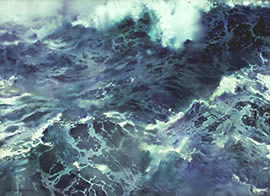
As a sailor sailing in between 40 degrees south and 50 degrees south a location called the roaring 40's was very treacherous because the force of the wind was so strong and the waves were even stronger because they had no land mass to stop their strength. Their great mass makes it difficult for a boat pass through. The purpose of my journey was to bring food from Australia to South Africa. The water in the roaring forties reveals that the water is one of the strongest forces on Earth. Many sailors have sailed through the roaring forties but many regular people do not venture through the forties because of the many treacherous dangers. The roaring forties have the sound of ocean waves crashing and the sight of large waves impacting one another.

Thursday, January 22, 2009

Earthquake Webquest- Day 1


Most earthquakes happen along the and the South American plate and the North American plate. I think most earthquakes happen along the the Ring of Fire, the North American plate and the South American plate because oceanic and continental crust is colliding and moving apart as the sea-floor spreads. This area is called the Ring of Fire. The closest earthquake to Manitou Springs occured on January 15, 2009 in Colorado at 12:10:02 PM at 40.953°N, 106.930°W at a magnitude of 3.2. The people living in that area of Colorado might of felt the earthquake but not generally felt. The shaking of an earthquake at a magnitude of 1 would be 20 times less shaking than an earthquake at 3.2. The energy from magnitude 1 would be like 6 ounces of TNT blowing up so 3.2 would be like 9 ounces of TNT exploding. An earthquake at the magnitude of 7.4 occured on Thursday January 15, 2009 at 10:49:39 AM (MST). The earthquake was located at 46.862°N, 155.156°E, East of the Kuril Islands. The depth was 36 km. deep and the distance was 430 km (270 miles) South of Severo-Kuril'sk, Kuril Islands, Russia, 590 km (365 miles) ENE of Kuril'sk, Kuril Islands, 1785 km (1110 miles) Northeast of TOKYO, Japan, 7245 km (4500 miles) Northeast of MOSCOW, Russia. To protect and prepare yourself and others for earthquakes learn about earthquakes and make safety kits. to stay safe indoors drop and take cover under a sturdy table or desk and hold on until shaking has stopped, avoid windows and glass. If outdoors when an earthquake strikes stay there move away from trees, signs, and electrical poles and stay away from buildings. Most people are killed not by the shaking itself but the falling buildings and flying glass.

Friday, December 5, 2008

Weather Fronts

Cold Front: The cold front moved in quickly and and pushed against the warm air creating clouds and then from the clouds came precipitation.

Warm Front: The warm front moved in slowly and created cumulus clouds and cirrus clouds above the cumulus clouds and then it precipitated.

Stationary Front: A cumulonimbus cloud was created when the warm and cold air met in the middle and that caused precipitation.

Occluded Front: The warm air got caught between the cool air and that caused a cumulonimbus cloud and then came precipitation.

Which type of front occurred this week to bring the cold weather and then snow? The front that occurred this week to the cold weather and then snow was a cold front.

Thursday, December 4, 2008

Thursday, November 27, 2008

Lima, Peru to Cape Town, South Africa

Travel time: 15 days
Direction traveling: Northeast/east
Were you successful? Yes
How many attempts? 2 attempts
What winds did you take advantage of or compete with during your travel? To reach my destination I took advantage of the prevailing westerlies and the horse latitudes the entire journey.

Thursday, November 20, 2008

Havana, Cuba to London, England

Travel time:9 days
Direction traveling:Northeast/East
Were you successful?Yes
How many attempts?1 attempt
How were you successful?I got to my destination in 9 days my scheduled time.
What winds did you take advantage of or compete with during your travel?I used prevailing westerlies the entire trip.

San Fransico to Sydney, Ausralia

Travel time:13 days
Direction traveling:Southwest
Were you successful? Yes
How many attempts? 1 attempt
How were you successful? I got to my destination in 13 days
What winds did you take advantage of or compete with during your travel? I used trade winds to get out of the horse latitude and then I used the trade winds for the rest of the journey to reach the prevailing westerlies.

Tuesday, November 18, 2008

Tuesday, November 4, 2008

London-Type Smog


One hundreds years ago in London, England the people burnt coal in factories and houses. This caused the air to be polluted with soot and smog. London-type smog forms when particles in coal smoke combine with water droplets in humid air. Today people in London burn alot less coal, therefore the air in London is much cleaner than one hundred years ago.

Wednesday, October 29, 2008

Earth's Atmosphere

Unlike the moon Earth as a very protective atmosphere. Earth been impacted by the same amount of meteorites as the moon , but Earth has an atmosphere so the crater washed away in a short time. On the moon though a crater can stay on the surface of the moon for 4 billion years. Earth's atmosphere can also keep heat in it and keep heat out which makes it possible for humans to live on Earth. The ozone layer protects Earth and the life on it from ultra violet rays. The moon can't keep its own heat in or out without an atmosphere so the temperatures on the moon are very extreme. Earth can also hold gases in its atmosphere. This makes it possible for human existence. Earth's atmosphere is suitable for living things it can hold in gases and heat, therefore it is different from the moon.

Wednesday, October 8, 2008

Monday, October 6, 2008

Space Exploration

The Science Of Rockets
Since the late 1950's NASA has used Atlas rockets. With Atlas rockets NASA is able to launch probes into space and satellites into orbit around Earth. Atlas rockets have been used in many missions for governmental and commercial enterprises.
The Space Program
NASA or The National Aeronautics and Space Administration began in 1958. Apollo 13 was launched on April 11, 1970and only spent 6 days in space. Instead of space rockets they launched probes into space.
Exploring Space Today
A new type of small robot for the International Space Station is called a personal satellite assistant floats next to an astronaut. The robot is powered by solar cells. The robot has not only camera and light but also a videophone.
Using Space Science On Earth
NASA says less than 1 percent of the U.S. budget is spent on the space program. NASA stresses its contribution to the country's economic welfare because many people think the funding should go towards education or medical research.